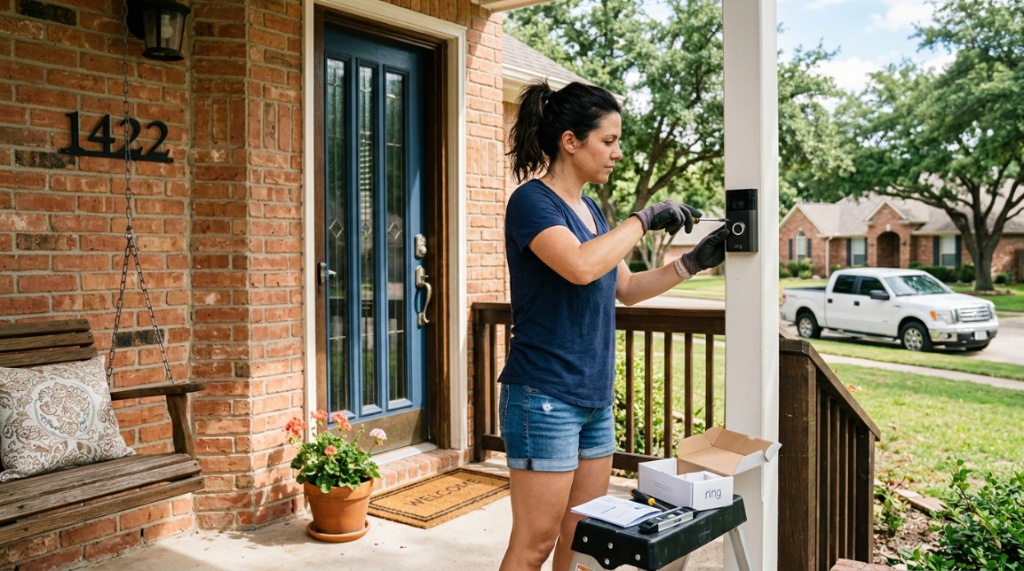
Texas weather is not a joke. One day it’s 105°F with brutal, direct sun, and the next day a sudden gullywasher floods your front porch. You need a video doorbell that can survive this climate, not just look sleek in a showroom. The problem is that choosing the wrong model can lead to dead batteries in August or a camera lens that fogs up after a humid morning. You don’t need another gadget; you need a reliable security tool built for your specific environment. Let’s cut through the marketing noise and find the perfect device that actually works on your Texas home, whether you live in Houston humidity or El Paso desert heat. This guide focuses on heat tolerance, connectivity, and real-world installation challenges specific to the Lone Star State.
Which Ring Doorbell Model Handles Texas Heat Best?
If you live in Texas, thermal performance is your number one priority. The best current models for extreme heat are the Ring Battery Doorbell Plus and the Ring Wired Pro, as they feature improved thermal management systems. Older models, like the first-generation Video Doorbell (2016), are notorious for shutting down when the metal faceplate hits 120°F in direct sunlight. You must look for models with a higher operating temperature range (usually up to 113°F or 45°C) and physical ventilation for the battery compartment.
Why High Heat Drains Batteries Faster in Texas
Lithium-ion batteries degrade faster when exposed to high temperatures. In Texas, a standard battery doorbell might last three months on a charge, but during July, that drops to six weeks. This happens because the chemical reaction inside the battery speeds up, causing internal resistance and voltage drops. To mitigate this, choose a model with a removable battery pack (easy installation) so you can swap it out quickly rather than taking the whole unit down to charge.
The “Texas Sun” Distortion Problem
Direct sun can cause the camera’s IR filter to malfunction, leading to washed-out video during the day. The Ring Wired Pro includes a dynamic color filter that adjusts to glare, but it still struggles if the sun hits the lens directly. If your porch faces west, you need a model with a wedge kit installation to angle the camera away from the sun’s peak path. Without this, the video will be useless during the hottest hours.
Best Placement for Shade and Airflow
Do not mount your doorbell inside a fully enclosed porch with no airflow, as the trapped heat will damage the electronics. In Texas, you need at least 4 inches of clearance above the unit to allow heat to dissipate. If you have a stone or brick exterior, remember that these materials absorb heat during the day and radiate it at night, keeping your doorbell hot long after sunset. Installing on wood or vinyl siding is cooler.
How Do I Ensure a Stable Wi-Fi Connection for My Ring in a Large Texas Home?
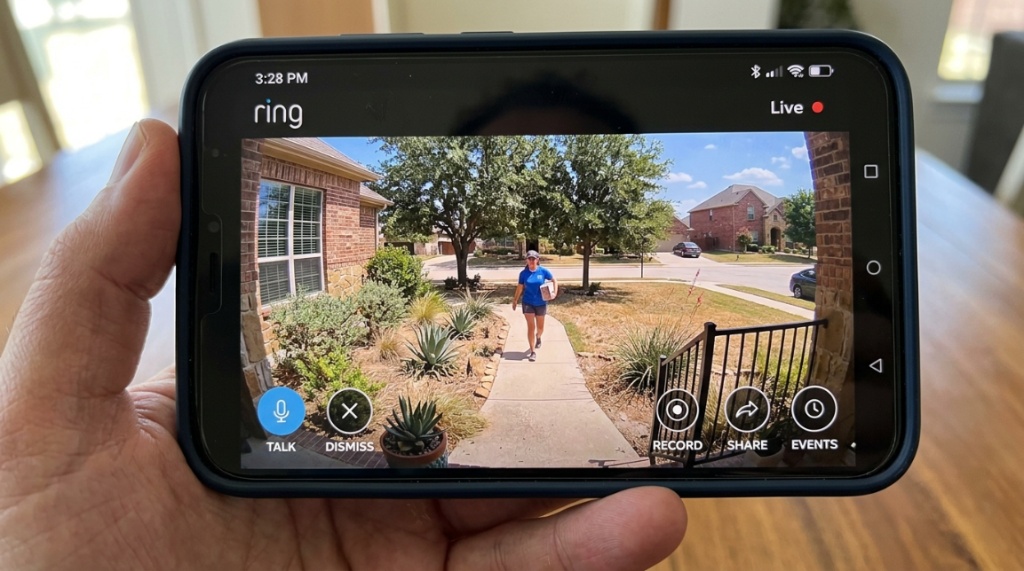
Texas homes are often massive, with thick brick walls that block Wi-Fi signals. You cannot rely on your router in the living room to reach your front door. A standard Ring doorbell uses 2.4GHz Wi-Fi, which travels further but is slower. If your signal drops, the doorbell will disconnect, and you will miss alerts. You need a mesh Wi-Fi network or a dedicated access point near the front entrance.
Why Your Router Might Not Be Enough
Stucco, brick, and even foil-backed insulation (common in Texas attics) severely attenuate wireless signals. If your doorbell is more than 50 feet from the router with two walls in between, you will experience lag. Test your signal strength using the “Device Health” section in the Ring app before mounting. If the RSSI (Received Signal Strength Indicator) is above -60 dBm, you will have persistent disconnects.
Using a Chime Pro as a Range Extender
Ring’s Chime Pro is not just a speaker; it acts as a dedicated Wi-Fi extender for your doorbell. This is often the cheapest solution for Texas ranch-style homes where the front door is far from the main hub. Place the Chime Pro halfway between the router and the doorbell, ideally in a hallway or closet. This creates a dedicated network just for your security devices, freeing up bandwidth.
Wired vs. Battery for Connectivity
If you have an existing doorbell transformer (16V to 24V), choosing a wired model is better for connectivity. Wired models can use the “Dual-Band” Wi-Fi (5 GHz), which is faster and less congested—crucial in crowded Texas suburbs where every house has a router. Battery models only use 2.4GHz. Check your transformer voltage with a multimeter before buying; many Texas homes built pre-2000 have outdated 10V transformers that won’t power the new Pro models.
Is the Ring Battery Doorbell Plus Worth It for Texas Renters?
Yes, for renters, the Ring Battery Doorbell Plus is often the right Ring Doorbell Texas option because it requires zero wiring and installs with two screws. However, consider the heat factor—you cannot hardwire it to bypass the battery. The biggest advantage is portability: when you move, you take it with you. The “Plus” model specifically offers a head-to-toe view (150 degrees), which is essential for catching packages left on the ground, a common occurrence in Texas where delivery theft is rampant.
Battery Life Realities in Humid Coastal Areas
In Galveston or Corpus Christi, humidity invades the device. The Ring Plus has a sealed battery but the charging port can corrode if moisture gets in. To avoid this, always use the included rubber plug on the USB-C port, even if you charge inside. In humid zones, expect to charge the battery every 2 to 3 weeks during summer because the constant heat forces the motion sensors to work harder to detect heat signatures.
Installation Flexibility Without Drilling Damage
Renting means you often cannot drill into brick or stucco. The Battery Plus works with a “no-drill mount” using strong adhesive tape, but in Texas heat, adhesive fails when the surface temp exceeds 100°F. Instead, use a mounting bracket that attaches to the screws of your existing doorbell chime (even if it’s not powered). This gives you a solid mount without damaging the rental property’s facade.
Video Quality and Night Vision
The Plus model has 1536p HD+ resolution. This is critical for Texas nights where humidity creates a foggy lens. The camera uses “Color Night Vision,” which stays in color if there is low ambient light—like streetlights. This helps identify car license plates or a delivery driver’s uniform, which is much harder in grayscale. The wide field of view also helps capture the approach of a person, not just their face.
When Should I Choose the Ring Wired Pro Instead of a Battery Model?
You should choose the Ring Wired Pro if your home has a working doorbell transformer and you are tired of charging batteries. The Wired Pro offers “Radar Zone” technology, which uses radar to detect motion precisely, minimizing false alerts from heat waves or wind-blown leaves—a major issue in West Texas. This model is also ideal for continuous recording (with a Ring Protect Plan), which battery models cannot do.
Understanding Pre-Roll and Full Video Recording
Battery models only record when motion is detected, missing the 4 seconds before the trigger. The Wired Pro has “pre-roll” that captures 4 seconds of black-and-white footage before the event, ensuring you see the person’s face as they approach. In a state where package theft is a serious issue, this continuous buffer is a legal necessity for evidence. You can see the thief actually walking up, not just their arm reaching for the box.
The Power Requirement Check
Before buying the Wired Pro, check your transformer. It must supply 16-24V AC and at least 20VA. Many Texas homes have the transformer hidden in a closet or attic. If it’s too weak, the doorbell will boot loop (constantly restart). You can replace the transformer yourself for $20, but that requires electrical work. If you are uncomfortable with wiring, stick to battery or pay an electrician.
Advanced Motion Detection Features
The Wired Pro includes two motion zones: “radar” zones for large areas and “infrared” for the immediate porch. This dual-layer detection helps in Texas because the temperature differential between a hot car engine and the background can trigger IR sensors. Radar is less prone to heat signatures, so it ignores the hot asphalt and only alerts when a moving body crosses the threshold.
Can a Ring Doorbell Withstand Texas Thunderstorms and Hail?
Yes, all current Ring models are IP55 weatherproof rated, meaning they resist dust and low-pressure water jets. However, they are not IP67 (submersible). In a Texas hailstorm, the doorbell can crack if hit by a golf-ball-sized hailstone. The mounting bracket usually survives, but the lens might shatter. You should buy a protective metal cover or shield to minimize the risk.
Understanding the IP55 Rating Limits
IP55 means the device is protected against dust (level 5) and water jets (level 5). This handles rain, but not a high-pressure hose cleaning your porch. The port for wiring is the weakest point. If you have a wired model, ensure the wires are connected tightly and the rubber gasket is seated correctly. If water gets into the wiring terminals, it will short-circuit the transformer.
Lightning Surge Protection for Texas Storms
Texas is the lightning capital of the US. The low-voltage wiring connected to your doorbell runs alongside high-voltage lines on the street. A nearby lightning strike can send a surge through the wires, frying the doorbell’s circuit board. Unplug the chime kit and consider adding a surge protector designed for doorbells. It’s a cheap insurance policy that prevents you from having to replace a $250 doorbell every storm season.
High Humidity and Fogging Issues
After a sudden rainstorm, condensation can build up inside the lens. If you see moisture, keep the device powered on—the heat from the internal processor will evaporate the moisture. Do not disassemble the device to dry it out, as this voids the warranty. In extremely humid areas like East Texas, applying a thin layer of dielectric grease to the battery contacts prevents corrosion.
Ultimately, picking the right model comes down to your specific Texas microclimate. If you are still torn between price and durability, review the full comparison matrix on our guidance page for the right Ring Doorbell Texas to see side-by-side specs and user reviews. You need a device that operates flawlessly during our harsh summer, not just one that looks cool in your Amazon cart.
How Much Should I Pay for a Ring Doorbell in Texas in 2026?
In 2026, prices have stabilized. You should expect to pay between $89 and $229 depending on the model. The Battery Basic starts around $99, the Battery Plus around $169, and the Wired Pro around $199. However, Texas tax rates (up to 8.25%) and mandatory shipping fees can add $20 to the total. Never pay retail during back-to-school season or Black Friday, as major retailers like Best Buy or H-E-B often run local promotions.
Should I Buy the Ring Protect Plan in Texas?
Yes, but only for video storage. The Basic Plan ($4.99/month) gives you 180 days of video history and the ability to share videos. In Texas, this is crucial for police reports regarding theft or trespassing. The Plus Plan ($10/month) adds extended warranties and discounts. If you don’t pay for a plan, you only get a snapshot, not full video, making your doorbell useless for security evidence.
Where to Buy for the Best Return Policy
Buy from stores with a generous return policy. Texas heat can ruin a unit within the first week. Costco often bundles two units but has a 90-day return policy on electronics. Amazon offers a 30-day refund. Avoid buying from third-party sellers on eBay who might sell desert-worn units from Arizona. Always confirm that the serial number is registered with Ring for warranty purposes.
Comparing the Cost of Wired Installation
If you hire a licensed electrician to run new low-voltage wiring in Texas, expect a bill between $150 and $300. This often exceeds the cost of the doorbell itself. To save money, consider using the battery version and buying a $30 plug-in adapter if you have an outlet near the door. This gives you wired power without complex electrical work, and it is legal in Houston and Dallas without a permit.
Why Does My Ring Doorbell Keep Disconnecting During Texas Peaks?
The issue is not the doorbell; it is the internet spectrum congestion. During peak hours (6-9 PM), all your neighbors are streaming video, clogging the 2.4GHz band. Your doorbell keeps disconnecting from wifi because the signal is interfered with by other devices. To fix this, change your router’s channel to a less congested one, usually channel 1 or 11 on 2.4GHz.
Tackling ISP Throttling
Some Texas ISPs throttle upload speeds during peak summer hours when everyone is using AC and streaming. Test your upload speed—Ring needs at least 2 Mbps for smooth video. If you have satellite internet (common in rural areas like West Texas), the latency is too high for real-time alerts. Switch to a cellular data backup plan if your primary internet is unreliable.
Heat-Induced Processor Throttling
When the CPU gets too hot, it reduces its performance to cool down. This slows down the Wi-Fi radio, making the doorbell drop packets. If your doorbell is in direct sunlight, the internal temperature exceeds 140°F. Building a small wood awning or just attaching a plastic sun shield significantly reduces the ambient temp and stabilizes connections.
Power Supply Stability
For wired models, a fluctuating voltage (common in rural Texas grids) causes reboots. Your transformer might provide 16V when idle but drop to 12V when the doorbell activates its camera. You need a “kit” that includes a capacitor to smooth out voltage drops. This often solves random disconnects that occur whenever someone pushes the button.
What Features Differentiate the Ring Pro from the Nest in Texas Homes?
While we focus on Ring, you should know that Ring generally handles heat better than the Nest because Ring uses a plastic housing that insulates, whereas Nest uses a metal housing that conducts heat, causing faster shutdowns. Ring’s mobile app is also lighter, requiring less bandwidth, which is perfect for slow rural internet. However, Nest offers better AI person detection if you have a Google ecosystem, Secure your property effectively by following our guide to Keep your home secure using the right smart devices.
Subscription Costs Comparison
Ring’s Basic Plan is half the price of Nest’s (which has no basic tier, only a $15/month tier). If you are cost-conscious in Texas, Ring wins. You can store video on a local SD card with other brands, but Ring requires the cloud. This is a yearly cost of $60, which is the price of a nice dinner out in Austin.
Physical Size and Durability
The Ring Pro 2 is smaller and less obtrusive, which reduces the surface area exposed to sun. The Nest is bulkier. In Texas windstorms, a smaller device catches less wind resistance, keeping the mounting screws tighter. Over time, a larger, heavier doorbell can loosen its screws on a stucco wall, requiring re-tightening.
Integration with Texas Smart Home Systems
If you use Alexa (Amazon), Ring integrates flawlessly with Echo Show devices. This allows you to see the camera on a TV or screen without pulling out your phone. Nest integrates with Google Home, but Google Assistant is less common in older Texas homes. Choose your ecosystem first, then choose the doorbell. Don’t mix ecosystems, as it becomes a nightmare to manage.
How Do I Install a Ring Doorbell on Stucco or Brick in Texas?
Installing on stucco is tricky because the plastic anchors provided in the box are too short. For brick, you need a hammer drill with a masonry bit. The standard screws will strip out of brick, so you must use special heavy-duty anchors that expand inside the brick hole. If you screw directly into brick without a pilot hole, you will crack the brick and cause moisture intrusion.
Step-by-Step for Stucco Installation
First, use a pencil to mark the mounting holes. Second, drill with a 3/16-inch masonry bit, but be careful—stucco can blow out if you go too fast. Third, push plastic anchors in with a rubber mallet. Fourth, thread the screws gently, as overtightening crushes the stucco. Finally, caulk around the plate with a high-temp silicone sealant to prevent water from getting behind the stucco.
What to Do with Existing Chime Wires
You can either connect the wires for power (if voltage is correct) or cap them off and run the battery. If you cap them, use wire nuts. If you connect them, wrap them around the terminal screws and tighten. Always turn off the breaker first. In Texas, electricity is 120V at the breaker, but the transformer lowers it to 16V—still, it’s safer to cut power.
Hiding the Transformer and Wires
Texas homes often have a conduit pipe for the doorbell. If you are replacing an old unit, use the existing conduit. If not, you can buy a decorative junction box cover. Avoid running wires underground from a neighboring building, as Texas termites and moisture can degrade the insulation, causing shorts.
Can I Return a Ring Doorbell If It Fails in Texas Heat?
Yes, Ring offers a 1-year limited warranty that covers thermal failure, provided you didn’t disassemble it. The process is easy via the app. You send in the old unit, and they ship a replacement. However, Amazon’s return window is 30 days. After that, you are bound by the manufacturer’s warranty. Keep your receipt because Ring often asks for proof of purchase.
How to File a Warranty Claim
Open the Ring app, go to Device Health, and select “Test Wi-Fi” to ensure it’s not an internet issue. Then call the support hotline. In 2026, they offer an “Advanced Replacement” option where they send the new unit first and put a hold on your credit card. This cuts the downtime to 48 hours instead of two weeks. This is crucial when your porch is vulnerable to porch pirates.
State-Specific Consumer Laws
Texas has the Deceptive Trade Practices Act. If the doorbell fails due to a known defect (like the 2024 firmware bug that overheated devices), you are entitled to a full refund, not just a replacement. Mention this if the representative tries to give you a refurbished unit instead of a refund. Knowing your rights helps you negotiate.
Don’t Throw Away the Mounting Bracket
When filing for warranty, they may ask you to return the complete kit. If you lost the bracket, you will incur a $25 fee. Keep the entire box and accessories in a safe place. This is especially important for renters who move, as the warranty is transferable to the replacement, but only if you have the full unit.
Frequently Asked Questions
Does the Ring Doorbell work in extremely cold Texas winters?
Yes, Ring operates down to -5°F, which is colder than any Texas winter typically gets. However, in the Panhandle plains, wind chill can affect the camera’s plastic housing, making it brittle. The battery will drain faster in cold conditions, so keep a spare charger handy. The device will still record, but the battery efficiency drops by about 20%.
Is a Ring Doorbell good for a Texas apartment complex?
If you live in a gated community, you can use the “Local” mode to deactivate the camera when you are home. This is helpful because Texas apartments have strict privacy regulations—you cannot point the camera at your neighbor’s door. Use the privacy zones to block out common hallways. Also, check your lease: some Texas HOAs prohibit visible cameras on front doors.
Do I need a special transformer for a Ring Doorbell?
Yes, most Ring models need 16V to 24V AC. If your transformer is smaller (6V to 12V), the doorbell won’t stay awake. You can buy a compatible transformer at any Home Depot in Texas. The cost is around $15. You can often replace it yourself, but if you live in a historical district (like Galveston), you might need a licensed electrician due to local codes.
Can I use a Ring Doorbell without a chime?
Yes, you can buy the Ring Plug-in Chime or skip it entirely and use your phone for alerts. In Texas, where hallways are often long, the plug-in chime is useful. Alternatively, you can use your Amazon Echo devices as chimes. You do not need a mechanical chime to operate the doorbell; it simply provides a home audio alert.
Does Ring have a monthly fee in Texas?
It is optional, but you need it for video history. Without a plan, you get real-time viewing but cannot replay events. For security, the $4.99/month plan is worth it. There are no Texas-specific taxes on digital services, so the price is exactly as advertised, unlike in some states, which add a surcharge.
How to remove a Ring Doorbell from a Texas brick wall?
Use a security driver bit to loosen the bottom screw. Then use a flathead screwdriver to unlock the release latch at the top. Pull the device straight off the bracket. Be careful in heat—the plastic may be soft. If the screws are stuck due to rust, spray a penetrating oil like WD-40 and wait 10 minutes before forcing it.
What is the warranty period for Texas residents?
Ring offers one year from the original purchase date. Texas does not extend this, but the Magnuson-Moss Warranty Act protects you if the product fails due to a manufacturer defect. If your device fails due to extreme heat (above operating specs), you might be out of luck. However, often Ring offers a “goodwill” replacement if you are a repeat customer.