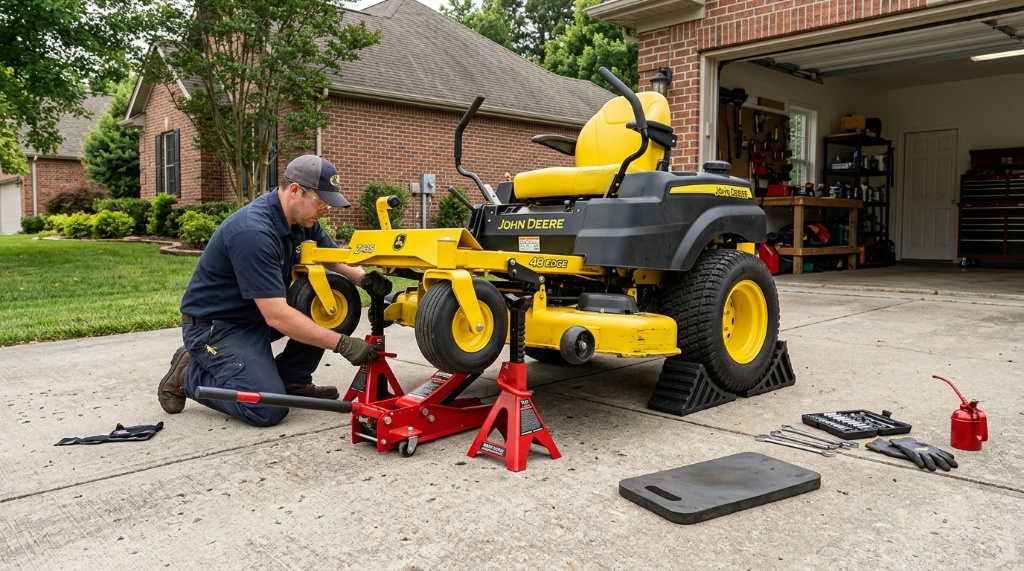
Reaching under a riding mower to clear a clogged deck, sharpen a blade, or inspect a belt is one of the most dangerous maintenance tasks a homeowner can face. A jack that slips or a deck that drops can cause serious injury in seconds. The safest approach is to lift the machine with a stable, purpose-built device and lock it in place before you ever put your hands underneath. A heavy-duty mower lift by MoJack is designed for exactly this kind of work, but the lift itself is only one part of a safe routine. This guide covers the full process, from preparation to the checks that keep you out of harm’s way.
Quick Answer
To work safely under a riding mower, park on a hard level surface, disconnect the spark plug, and lift the machine with a rated mower lift or ramps instead of a standard floor jack or cinder blocks. Engage the lift’s locking mechanism before going underneath, chock the wheels, and never rely on hydraulics or gravity alone. Inspect the lift and mower before every use, and keep body parts clear of the deck until it is fully secured.
Key Takeaways
- Hydraulic jacks and cinder blocks are not safe supports; only mechanical locks or rated stands should hold the mower up while you work underneath.
- Always disconnect the spark plug and remove the key before lifting, so the engine cannot start or the blades cannot engage.
- A level, hard surface such as concrete is essential; grass, gravel, and sloped driveways cause lifts and stands to shift.
- Inspect the lift, deck, and blades before every session, and never place any part of your body under an unsupported mower.
- Blade work carries its own risks, so treat sharpening and removal as a separate safety procedure from the lift itself.
Why Working Under a Riding Mower Is So Risky
The main danger is not the height of the mower; it is the weight and the way that weight can move. Riding mowers typically weigh several hundred pounds, and most of that mass sits in the engine, transaxle, and deck. When you lift one corner, the machine can pivot, roll, or drop suddenly if the support is not locked.
Three failure points cause most accidents:
- Hydraulic creep. A floor jack or hydraulic lift can slowly lose pressure. What feels stable for a minute may sink an inch while you are underneath.
- Unstable bases. Cinder blocks, stacked wood, and car ramps can crack, slide, or tip under a mower’s weight and shape.
- Rolling and pivoting. If the wheels are not chocked and the surface is not level, the mower can roll off the support entirely.
The practical rule that follows from these risks is simple: never trust anything that depends on fluid pressure or friction alone to hold the mower up while you are underneath it. Use a device with a mechanical lock, and treat that lock as the only thing keeping you safe.
What You Need Before You Start
Gather everything before you lift, so you are not walking away from a raised mower to fetch a tool. A short list keeps the job controlled:
- A mower lift or ramps rated for your machine’s weight, with a mechanical locking mechanism
- Wheel chocks
- Work gloves and eye protection
- A socket set and wrenches for the specific task
- A spark plug wrench or boot puller
- A bright, portable work light
- A hard, level surface such as a concrete garage floor or driveway
If you do not own a lift, do not substitute a car jack and blocks. Either buy or borrow a properly rated mower lift, or move the mower to a location where you can safely use ramps. A lift is a one-time purchase that makes every future maintenance job safer, which is why many owners treat it as essential equipment rather than an optional accessory, For more lawn care guides, learn about fixing nutrient lockout in new lawn to keep your turf healthy.
Step-by-Step: Lifting and Securing the Mower
Follow these steps in order. Skipping one is the most common way people get hurt.
- Park on a hard, level surface. Concrete is ideal. Avoid grass, gravel, dirt, and any slope.
- Set the parking brake and turn off the engine. Remove the key and put it in your pocket so no one can start the mower.
- Disconnect the spark plug. Pull the boot off the plug, or use a plug wrench to loosen it. This prevents accidental ignition and blade engagement.
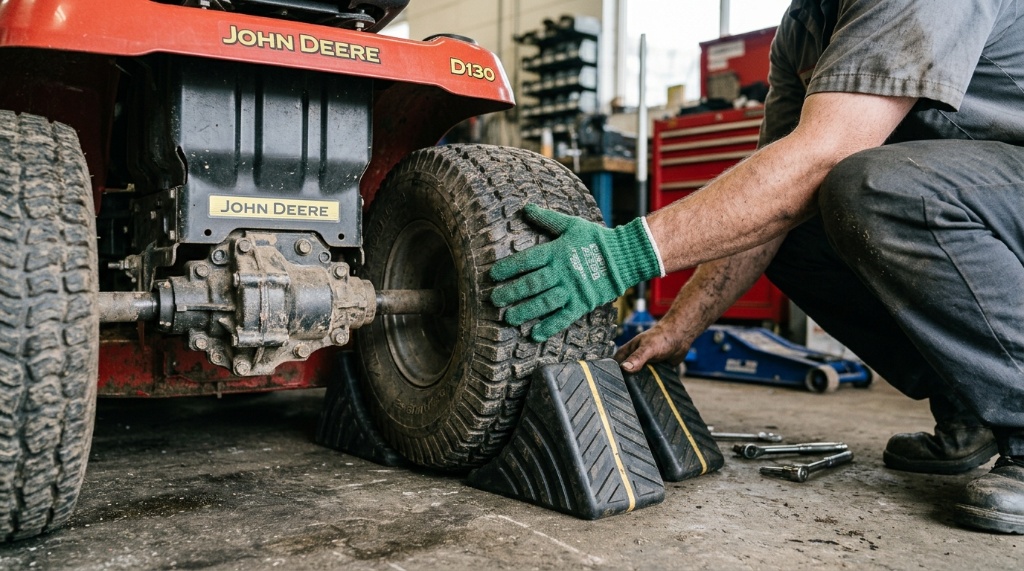
- Chock the wheels that stay on the ground. Place chocks on both sides of at least one wheel.
- Position the lift under the correct lifting point. Check your mower’s manual for the recommended lift location, usually the front axle or frame.
- Raise the mower slowly. Watch for any sign of the lift tipping or the mower shifting. Stop immediately if either happens.
- Engage the mechanical lock. Do not rely on the hydraulic cylinder to hold the mower up. Lower the lift onto its lock pin or locking bar until it is fully seated.
- Give the mower a firm nudge. A gentle push should not move the machine. If it rocks or shifts, lower it and start over.
- Double-check everything before going underneath. Confirm the lock is engaged, chocks are in place, and the spark plug is still disconnected.
Once the mower is locked and stable, you can work underneath with far more confidence. Keep your movements slow and deliberate, and never reach past a point where you cannot see what your hands are doing.
Common Mistakes That Cause Injuries
Most accidents under a mower come from a small set of avoidable errors. Watch for these specifically:
- Using a car jack alone. A hydraulic jack is a lifting tool, not a support. It can fail without warning.
- Stacking blocks or bricks. These crack and shift under concentrated load and offer no locking mechanism.
- Working on grass or a slope. Soft or uneven ground lets the lift sink or slide.
- Leaving the spark plug connected. Even a small bump can engage the starter or accidentally rotate the blade.
- Skipping the wheel chocks. Without chocks, the mower can roll off the lift as you work.
- Reaching under a running or recently run engine. Exhaust components stay hot for a long time and can cause serious burns.
- Rushing the lock check. The lock is the single most important safety feature on the lift. Confirm it every time.
- Letting children or pets nearby. Keep the work area clear so no one bumps the mower or the lift.
Each of these mistakes is easy to fix once you know about it. The habit that matters most is refusing to go underneath until the mower is locked, chocked, and electrically disabled.
Sharpen or Replace Blades Safely
Blade work is the most common reason to lift a mower, and it deserves its own precautions. Even with the mower off and the spark plug disconnected, a blade can still hold tension or shift unexpectedly.
Before touching a blade:
- Confirm the spark plug is disconnected and the key is out of the ignition.
- Wear thick gloves; mower blades are sharp even when dull.
- Use a block of wood to prevent the blade from spinning while you loosen the mounting bolt.
- Check the blade for cracks, bends, and heavy nicks. A damaged blade should be replaced, not sharpened.
- Balance the blade after sharpening, or install a new pre-balanced blade.
- Torque the blade bolt to the specification in your mower’s manual.
If you are unsure about torque specs or blade condition, replacing the blade is usually cheaper and safer than trying to extend the life of a worn one. A balanced, undamaged blade also protects the mower’s spindle and bearings, which is an added long-term benefit, For more lawn care guides, learn about fixing nutrient lockout in new lawn to keep your turf healthy.
Maintaining Your Lift for Safe Repeated Use
A lift only keeps you safe if it stays in good condition. Inspect it before each use and address problems immediately:
- Check the locking mechanism engages fully and does not slip.
- Look for cracks, bends, or excessive wear in the frame and lifting arms.
- Verify the hydraulic cylinder holds pressure; slow sinking means it needs service.
- Keep the lift on a clean, dry surface to prevent rust and debris buildup.
- Follow the manufacturer’s lubrication and inspection schedule.
If any part of the lift looks compromised, stop using it until it is repaired or replaced. A lift that fails while you are underneath the mower is exactly the scenario the equipment is meant to prevent.
Frequently Asked Questions
Can I use a car jack to lift a riding mower?
You can use a car jack to raise the mower, but never as a support while you work underneath. A hydraulic jack can lose pressure and drop the load. Always transfer the weight to a mechanical lock or rated stand before putting any part of your body under the mower.
Is it safe to work under a mower on ramps?
Ramps can be safe if they are rated for the mower’s weight, placed on a hard level surface, and paired with wheel chocks. They work well for tasks that only need the front or rear raised. For full under-deck access, a dedicated mower lift with a locking mechanism is usually more stable.
Do I really need to disconnect the spark plug?
Yes. Disconnecting the spark plug is a simple step that prevents the engine from starting or the blades from engaging if someone bumps the controls. It takes a few seconds and eliminates an entire category of accidents.
How often should I inspect my mower lift?
Inspect the lift before every use, and do a more thorough check of the locking mechanism, hydraulic cylinder, and frame at least once a season. Any sign of slipping, cracking, or slow sinking means the lift should be serviced or replaced before further use.
What surface is safest for lifting a riding mower?
Hard, level concrete is the safest choice. It does not sink or shift under the weight of the lift and mower. Grass, gravel, and sloped surfaces are unsafe because they let the base move and can cause the mower to tip or roll.
Can I leave a mower raised on a lift overnight?
It is best not to. Even with the lock engaged, leaving a mower raised for long periods puts stress on the lift and the mower’s frame. Lower it when you finish work, and re-lift it the next time you need access.
Conclusion
Working under a riding mower is safe when you control the weight instead of trusting it to luck. Park on concrete, disconnect the spark plug, lift with a rated device, lock it in place, and chock the wheels before you go underneath. Inspect your lift and mower before every session, and treat blade work as a separate task with its own precautions. If you maintain those habits, you can service the deck, blades, and belts with confidence and get back to mowing without a trip to the emergency room.