Key Takeaways
- Motor watts measure electricity used, not actual cleaning strength.
- Air watts combine airflow and suction pressure into one useful number.
- Pascals measure pressure, and robot vacuum brands often advertise them.
- Airflow and suction work together, so both matter.
- Brushes, filters, and seals often affect results as much as raw power.
Vacuum boxes are full of big numbers. Some claim 20,000 pascals. Others promise 1,600 watts or 250 air watts. However, these numbers measure different things. Comparing them directly leads to poor buying choices. This guide explains what each number means. You will learn to read specs with confidence.
Why Suction Numbers Confuse Shoppers
Manufacturers pick the number that looks best on the box. Therefore, one brand may list watts while another lists pascals. You cannot compare those two figures side by side. Each unit measures a different part of the machine.
Marketing adds more confusion. A bigger number feels like a better product. Yet a high number does not always mean better cleaning. It depends on what the number actually measures and how the maker tested it.
Testing conditions also vary. Some brands measure suction with nothing attached. Others test through a hose and floor tool. These choices change the results a lot. As a result, two vacuums with the same rating can perform very differently at home.
Consider what suction really does. A vacuum creates lower pressure inside the machine than outside it. Air rushes in to fill the gap and carries dust along. Two things decide how well this works. One is the pressure difference. The other is how much air moves through the machine.
According to Dreame, suction is the strength that pulls air in, while airflow is the volume of air moved. You need both for good cleaning. A strong pull with little airflow cannot carry debris away. Similarly, lots of airflow with weak pull cannot lift dirt from carpet. Keep this pair in mind as you read on.
Motor Watts: The Most Misleading Number
Watts appear on many corded vacuums. This number shows how much electricity the motor uses. It does not show how much suction reaches the floor.
The reason is simple. Motors lose energy as heat and noise. An efficient motor turns more electricity into airflow. A poor motor wastes much of it. Therefore, two vacuums with the same wattage can clean very differently.
Dreame notes that most household vacuums range from 500 to 1,500 watts. It also says a higher wattage does not always mean better performance because efficiency matters more. This advice is worth remembering when you see a huge number on a package.
Regulation has also changed the market. European Union ecodesign rules first capped vacuum motor power at 1,600 watts. They later lowered the limit to 900 watts. Manufacturers then had to improve efficiency instead of adding raw power. Cleaning performance did not fall as a result. This shows that wattage alone tells little about results.
Use watts only as a rough guide. Treat it as a measure of energy use and running cost. Look to other numbers for real cleaning ability.
Air Watts: A More Useful Measure
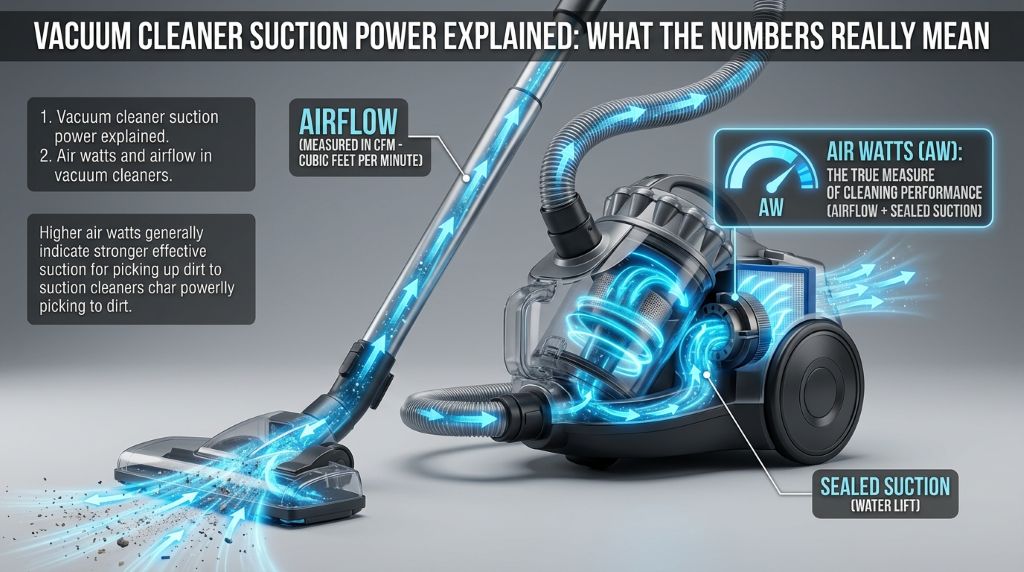
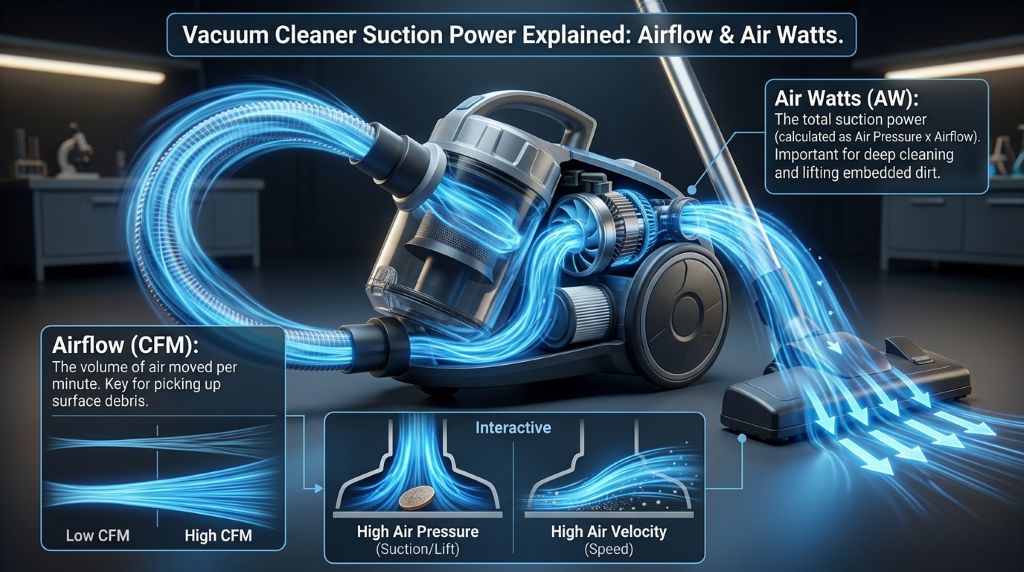
Air watts give a better picture of suction. The unit combines airflow and pressure into one figure. Wikipedia explains that air watts equal airflow in cubic meters per second multiplied by suction pressure in pascals.
This measurement reflects the power of the moving air itself. It is always lower than the motor’s electrical watts because of energy losses. However, it tells you how much useful work the air can do.
The same source notes that two vacuums with the same air watts have essentially the same suction power. Meanwhile, two vacuums with the same electrical watts can differ widely. Therefore, air watts make fairer comparisons.
Dreame offers rough ranges for cordless stick vacuums. Use them as general guidance, not strict rules.
- Under 100 air watts: better for light cleaning and hard floors
- 160 to 180 air watts: strong for everyday stick vacuum use
- Over 200 air watts: better for deep cleaning and thick carpets
Keep one caution in mind. These ranges come from a manufacturer. Testing methods can differ between brands. Look for independent reviews that measure performance on real floors.
Also remember that air watts are not always listed. Many brands skip them. In that case, look at other specs and test results.
Pascals, Water Lift, and Airflow
Pascals measure pressure. According to Narwal, a higher pascal value means stronger suction. Robot vacuum brands often use this unit. Dreame lists rough tiers for robot models, with basic units near 2,000 to 3,000 pascals and stronger ones above 7,000 pascals.
Pascals alone have limits. They show the pressure the machine can create. They do not show how much air moves. A robot with a high pascal rating and a tiny airflow path may still struggle. Furthermore, pascal claims often come from sealed lab conditions. Real floors leak air, so results drop.
Water lift is another pressure measure. It shows how high the vacuum can lift a column of water. Bigger numbers mean stronger suction. You may see it on shop vacuums and older models. It measures the same idea as pascals, just in different units.
Airflow appears as CFM, or cubic feet per minute. This tells you how much air passes through in one minute. Narwal explains that high airflow helps a vacuum clean larger areas more quickly. Airflow matters most on hard floors and for picking up loose debris.
One forum discussion on Elektroda points out that manufacturers can overstate airflow by measuring it with no restriction. That figure looks better but is less realistic. Airflow and pressure both drop as the vacuum works through a hose and floor tool. Therefore, the best specs report both values under real conditions.
What Matters Beyond the Numbers
Numbers describe the motor. They do not describe the whole machine. Several other parts shape real cleaning results.
The brush head matters a lot. A motorized brush roll loosens dirt from carpet fibers. Without it, high suction still leaves embedded dust behind. On hard floors, a soft roller picks up fine debris without scatter.
Seals and hose design also count. Leaks let air escape before it reaches the filter. As a result, suction at the floor falls. A sealed system keeps more of the motor’s power where you need it.
Filters play a role too. A clogged filter blocks airflow and cuts suction quickly. Dreame notes that filters, brush rolls, and airflow design all matter alongside the suction rating. Regular care keeps performance close to the rated level.
Finally, bag or bin fullness affects results. A full bag or overfilled bin reduces airflow. Empty it before it reaches the top.
Use this simple checklist when you shop.
- Check which unit the brand uses, and do not compare unlike units.
- Look for air watts when the brand provides them.
- Read independent reviews that test on carpet and hard floors.
- Match the brush head to your floor types.
- Confirm that filters and bags are easy to replace.
Conclusion
Suction numbers tell only part of the story. Motor watts show energy use, while air watts show useful cleaning power. Pascals and water lift indicate pressure, and CFM measures airflow. Each figure has value, but none works alone. Understanding how these measurements work together can help you use a powerful vacuum for pet hair effectively, especially when choosing a model for demanding cleaning tasks.
Choose a vacuum by looking at the whole system. Compare like units, read independent tests, and match the brush head to your floors. Review the specs of your current vacuum today. Then use this guide to pick a model that truly cleans, not one that just lists the biggest number.
Frequently Asked Questions
What is a good suction power for a vacuum cleaner?
For cordless sticks, 160 to 180 air watts works well. Choose over 200 for thick carpets.
Are pascals or air watts more accurate?
Air watts are more complete because they combine pressure and airflow. Pascals measure pressure only.
Does higher wattage mean stronger suction?
Not always. Watts show electricity used, while efficiency decides how much becomes real suction.
Why does my vacuum lose suction over time?
Clogged filters, full bins, and blocked hoses usually cause this. Regular cleaning restores most performance.
Is airflow or suction more important?
Both matter. Suction lifts dirt, while airflow carries it away. Balanced designs clean best.